India Gold Conference 2026: MBR Brings Refining Into Focus as India Looks to a More Sustainable Gold Economy
Gold has accompanied human civilisation for thousands of years, serving as a medium of exchange, a store of wealth and a material of cultural significance. Gold coins circulated as currency in ancient societies, while later monetary systems linked national currencies to defined quantities of the metal. The classical Gold Standard became an important part of international monetary history during the 19th and early 20th centuries, before the Bretton Woods system eventually ended gold’s formal convertibility role in 1971.
Silver has followed a parallel course, becoming important to monetary systems, international trade while gradually acquiring a wider role. Today, gold remains closely associated with jewellery, investment, wealth preservation, while silver is increasingly relevant to electronics, solar technology, automotive applications, other industrial sectors.
The changing role of these metals has also increased the importance of refining. Gold, silver entering the market through mining, dore, old jewellery, industrial scrap require systematic recovery, assaying, purification before returning to commercial use. Refining, therefore, forms an important link between raw material, recycling, the finished bullion market.
India occupies a significant position within the global precious metals ecosystem, with gold deeply connected to household wealth and jewellery consumption alongside a steadily developing organised refining sector. Recycled gold has also become an important source of domestic supply, with the World Gold Council estimating that it accounted for 16% of India’s gold supply in Q2 2026. During the same quarter, gold demand stood at 131 tonnes, while expenditure reached a record INR 1,979 billion, highlighting the continuing significance of the metal within the Indian market.
The 23rd India Gold Conference 2026, held between 20 and 23 August at Taj Cidade De Goa Horizon, Goa, brought this changing industry environment into focus. With approximately 750 senior stakeholders participating, the conference provided a common platform for refiners, bullion dealers, jewellery manufacturers, banks, technology providers, assayers, policymakers and other participants across the precious metals value chain.
The central theme, “India Gold Vision: Recycle, Reform & Re-Innovate,” captured three areas that are becoming increasingly relevant to India’s precious metals sector. The conference began with a dedicated technical seminar on Gold Assaying, Hallmarking and Refining Technologies, followed by sessions covering gold recycling, dore import reforms, hallmarking, international bullion markets, investment demand and the outlook of the Indian gold market.
The programme also brought together prominent voices across the sector. Ms Richa Goel Agarwal, Chief General Manager, SEBI, attended the inaugural session as Guest of Honour. Mr Prithviraj Kothari, National President of the India Bullion & Jewellers Association, Mr Jignesh Shah, Mr Samit Guha, Managing Director-CEO of MMTC PAMP, Mr Rajesh Rokde, Chairman of the All India Gem & Jewellery Domestic Council, Mr Sachin Jain, Regional CEO India, World Gold Council, were among the prominent participants listed in the programme.
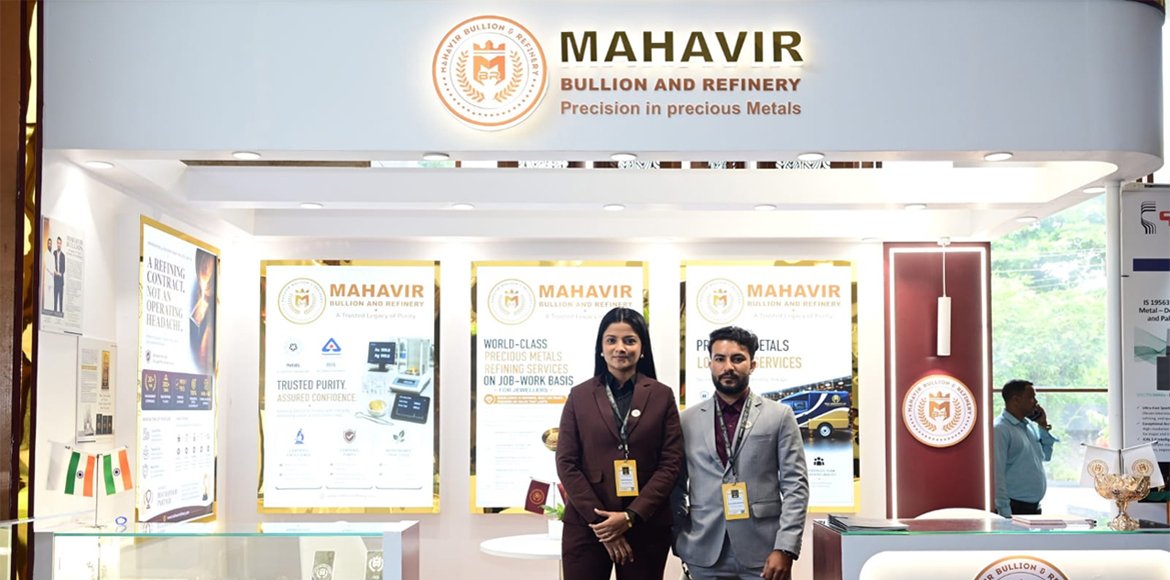
For Mahavir Bullion & Refinery Pvt. Ltd., the conference marked an important industry presence as the New Age Refinery Partner. The participation brought MBR’s expertise in refining into discussions around technology, recycling, assaying, bullion quality, along with the evolution of India’s organised refining sector. The MBR delegation comprised Jitendra Deshmukh, Vishwajeet Deshmukh,Tejaswini Deshmukh, and Harshvardhan Deshmukh, who represented the company during the four-day conference. Their presence provided an opportunity to connect with industry stakeholders, exchange perspectives on emerging requirements, explore developments across precious metals refining, bullion markets.
Based in Maharashtra, MBR operates across gold-silver refining, assaying, testing, bar- coin minting, secure precious metals logistics. Its refinery infrastructure at MIDC TTC Industrial Area, Pawane, is supported by NABL and BIS accreditation, with laboratory facilities for testing, assay functions. The company processes gold dore, silver dore, old jewellery, precious metal scrap, linking refining with recovery, reuse of existing metal.
This connection between refining, recycling is particularly relevant to India. A mature refining ecosystem allows precious metals already present within the economy to be recovered, tested, returned to productive circulation. It can also reduce dependence on newly mined material while creating greater traceability across the bullion chain.
The future of gold, silver refining will require far greater attention to technology, recovery, assaying, responsible sourcing, secure handling of precious metals. For India, the opportunity extends beyond meeting domestic demand. A strong refining sector can contribute to a more organised bullion market, improve recovery of recyclable metal, establish higher standards for quality, accountability.
IGC 2026 accentuated these priorities. Refining transforms recovered precious metal into a verified, usable resource once again. As global demand evolves, India’s refining sector will require better technology, responsible sourcing practices, efficient recovery systems, stronger standards. For MBR, the focus ahead will remain on advancing its refining capabilities, expanding responsible recycling practices, delivering credible assaying, minting, secure precious metals services.
The aim is to preserve the value of gold and silver while creating a system in which their recovery, refinement and reuse are safer, more transparent and more sustainable. For MBR, this means continuing to invest in responsible refining practices that support India’s growing precious metals ecosystem while setting higher standards for the future.
www.mahavirrefinery.com | connect@mbrpvt.com